Meet P.A.R.: The Ingenious Robotic Pixel Art Machine Redefining Mechanical Displays
In the fast-paced world of modern technology, displays are expected to be instantaneous, ultra-high-definition, and glowing with millions of vibrant sub-pixels. From OLED screens on smartphones to massive microscopic LED billboards in Times Square, the industry’s relentless pursuit of perfection leaves little room for deliberate slowness. Yet, ingenuity often thrives in reverse. Enter P.A.R., an interactive mechanical marvel designed and built by maker Zimm, which turns the concept of high-speed digital screens on its head.
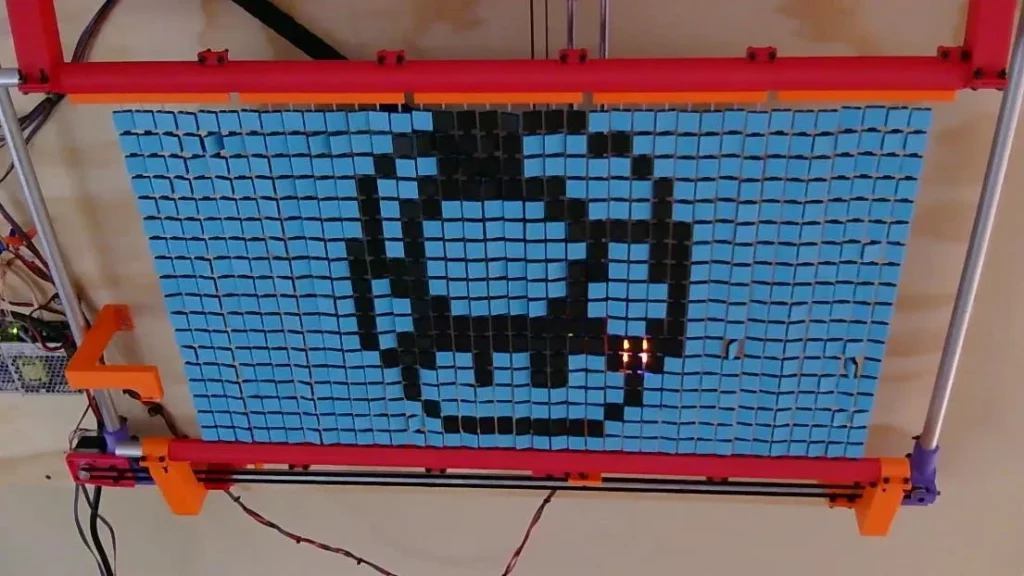
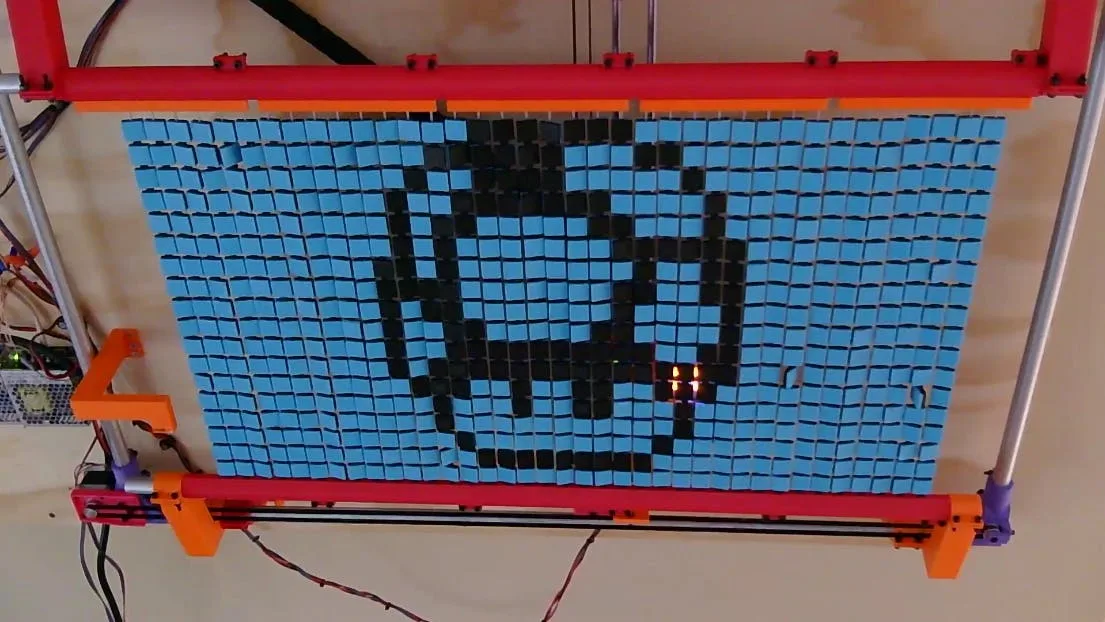
P.A.R. is not your typical display. It is a slow, methodical, and deeply hypnotic robot that draws black-and-white (or rather, black-and-cyan) pixel art across a 37-by-18 grid of specialized square disks known as "squisks." Rather than employing the traditional, complex, and costly approach of embedding an individual solenoid behind every single pixel, P.A.R. achieves the exact same functional outcome using a single, mobile CNC-style robot equipped with a smart mechanical tool head.
While the creation process is intentionally unhurried, the engineering philosophy behind it is brilliant. By substituting expensive hardware parallelism with intelligent sequential automation, P.A.R. opens up new avenues for kinetic art, interactive public installations, and low-cost mechanical displays.
Main Facts: How P.A.R. Reimagines the Flip-Disc Display
At its core, P.A.R. is an intersection of rapid prototyping, embedded systems, and mechanical engineering. Traditional flip-disc displays—commonly seen in older train stations, stock exchanges, and modern artistic installations—rely on a matrix of electromagnetic coils (solenoids). Each pixel requires its own dedicated solenoid and driving circuit to magnetically flip its disc from one side to the other. When scaled up, this architecture introduces massive wiring complexity, high power consumption, and substantial manufacturing costs.
Zimm’s P.A.R. completely bypasses this limitation. The physical display consists of 666 hand-assembled squisks arranged in a 37×18 grid. Each squisk is dual-colored, featuring a matte black face on one side and a striking cyan face on the other. Instead of driving each squisk with independent electronics, a two-axis robotic gantry moves a specialized tool head across the board, physically interacting with the disks one by one.
The hardware ecosystem powering this system is surprisingly lean. The central processing unit is an Arduino Nano ESP32, a compact microcontroller that elegantly bridges the gap between low-level hardware control and modern IoT (Internet of Things) connectivity. The Arduino manages the two-axis CNC motion, interprets server-side requests via Wi-Fi, and coordinates the actions of the tool head’s internal components.
The tool head itself is a masterclass in custom design. It houses a precision servo motor, a mechanical pin used to flick the squisks 180 degrees, and a TCS3200 color sensor module. This sensor is equipped with four integrated white-light LEDs and a color-to-frequency converter, allowing the robot to read the existing state of the board before executing any changes.
Chronology: From Concept to a Working Kinetic Canvas
The realization of P.A.R. was not an overnight success; it represents hundreds of hours of iterative design, CAD modeling, hardware debugging, and meticulous hand assembly.
Phase 1: Conceptualization and Mechanical Design
The project began as an exploration into reducing the hardware footprint of mechanical displays. Zimm recognized that while simultaneous updating (as seen in solenoids) is necessary for moving video, static or slowly changing pixel art does not require real-time parallel actuation. A single moving mechanism could theoretically achieve any static image given enough time. This realization led to the design of the squisks—custom square disks optimized for manual or mechanical rotation—and the layout of the 37×18 grid.
Phase 2: Prototyping the Gantry and 3D-Printing the Frame
Mechanical rigidity paired with lightweight construction was critical for the gantry system. Zimm utilized a 3D printer to fabricate over a thousand individual plastic components. These printed parts form the structural frame, the linear motion axes, the gantry carriage, and the intricate housing for the tool head. Alongside the printed elements, dozens of wires, stepper motors, and guide rails were integrated to ensure smooth, repeatable positioning across the grid.
Phase 3: Integrating the Brains and Sensors
Once the physical chassis was assembled, the electronics were integrated. Wiring the Arduino Nano ESP32 to the motor drivers and the TCS3200 color sensor established the baseline control loop. Programming the microcontroller required writing custom kinematics routines to translate grid coordinates into precise motor steps, ensuring the tool head could align perfectly with the center of every single squisk on the board.
Phase 4: Software Architecture and Web Integration
With the hardware functioning locally, the next milestone was connecting P.A.R. to the wider world. Zimm developed a dedicated web interface hosted via the ESP32’s network capabilities. This platform allowed external devices to interface with the robot over the internet. A server-side request queue was established to manage incoming pixel art submissions, transforming P.A.R. from a closed-loop benchtop experiment into a public, interactive art installation.
Phase 5: Calibration and the Verification Loop
The final development hurdle involved error handling. In any mechanical system, missed steps, friction, or jammed parts can cause a component to fail its intended action. To mitigate this, Zimm programmed P.A.R. with a closed-loop verification sequence. Before printing a new image, the robot scans the board. After printing, it scans the board again. If any squisk has failed to rotate properly, the robot detects the discrepancy and immediately corrects it, ensuring absolute visual fidelity.
Supporting Data & Technical Specifications
To truly appreciate the engineering behind P.A.R., it is helpful to examine the system’s technical composition and operational metrics:
- Display Resolution: 37 columns by 18 rows, yielding a total of 666 individual squisks.
- Pixel Architecture: Hand-assembled square disks (squisks) colored black on the primary side and cyan on the reverse. Each disk requires a precise 180-degree rotation to transition states.
- Processing Unit: Arduino Nano ESP32, combining robust computational logic with native Wi-Fi and Bluetooth connectivity.
- Motion Control: Two-axis CNC gantry driven by custom-coded kinematics for high-precision coordinate alignment.
- Tool Head Components:
- TCS3200 color sensor module (featuring 4 white-light LEDs and a color-to-frequency converter).
- Precision micro-servo motor for actuating the mechanical flipping pin.
- Physical metal/plastic pin designed to interface cleanly with the squisk geometry.
- Fabrication Requirements: Over 1,000 unique 3D-printed parts utilized across the frame, gantry, and mechanical assemblies.
- Connectivity Protocol: Cloud-integrated request queue accessible via a dedicated web application (
par.zimmzimm.com). - Open-Source Availability: Comprehensive project documentation, build logs, and source code made publicly available on GitHub and the creator’s official site.
Implications: The Future of Interactive Kinetic Art and Maker Innovation
P.A.R. is much more than a clever desktop novelty; it challenges conventional engineering wisdom regarding how we build and interact with public displays.
Democratizing Mechanical Displays
Traditional flip-disc displays are notoriously expensive. Commercial units require complex circuit boards, custom-molded magnetic components, and extensive wiring harnesses, placing them far out of reach for individual makers, small studios, or local art installations. By replacing hundreds of active electrical actuators with a single moving mechanical head, P.A.R. slashes the bill of materials. It demonstrates that kinetic art can be democratized, opening the door for hobbyists to build large-scale mechanical signage without breaking the bank.
The Power of Slow Technology
In an era dominated by hyper-responsiveness, P.A.R. introduces a refreshing element of "slow technology." The time it takes for the robot to scan, calculate, flip, and verify an image transforms the act of creation into a performance. Observers can watch the machine methodically solve the visual puzzle, pixel by pixel. This kinetic transparency creates a deeper psychological connection between the viewer and the medium, turning a static image transition into an engaging theatrical experience.
Open-Source Community Engagement
By releasing the source code, CAD files, and architectural documentation online, Zimm has positioned P.A.R. as a collaborative launchpad. The maker community thrives on projects that bridge software and heavy manufacturing. Already, enthusiasts are looking at ways to scale the concept—perhaps expanding the grid size, introducing multi-color palettes through rotational staging, or implementing machine learning algorithms to optimize the tool head’s pathfinding efficiency.
Reliability Through Self-Correction
One of the most profound engineering takeaways from P.A.R. is its reliance on verification loops rather than blind execution. In consumer robotics, open-loop systems often fail when physical wear and tear introduces drift or resistance. By incorporating a pre- and post-scan routine utilizing the TCS3200 sensor, P.A.R. acts as its own quality assurance inspector. This design pattern—where a machine constantly monitors its environment, executes a task, and then audits its own work—has broad implications for low-cost automation projects across the maker space.
Conclusion
P.A.R. stands as a testament to the power of creative problem-solving. By trading the brute-force complexity of hundreds of solenoids for the elegant simplicity of a single mobile gantry, Zimm has crafted a mesmerizing bridge between digital data and physical kinetic art.
Whether viewed as an exercise in micro-controller programming, a masterclass in 3D-printed mechanical design, or an interactive community canvas open to anyone with an internet connection, P.A.R. proves that innovation does not always require inventing new materials. Sometimes, it simply requires looking at an old technology—the flip-disc display—and asking how much further a single, clever robot can take it.
For those inspired to explore the project further, full documentation, build breakdowns, and the interactive web portal can be found at the official project repository and Zimm’s official website.